From Crawling to Cruising: Understanding the Milestones of Your Baby’s First Step
From Crawling to Cruising: Understanding the Milestones of Your Baby’s First Step
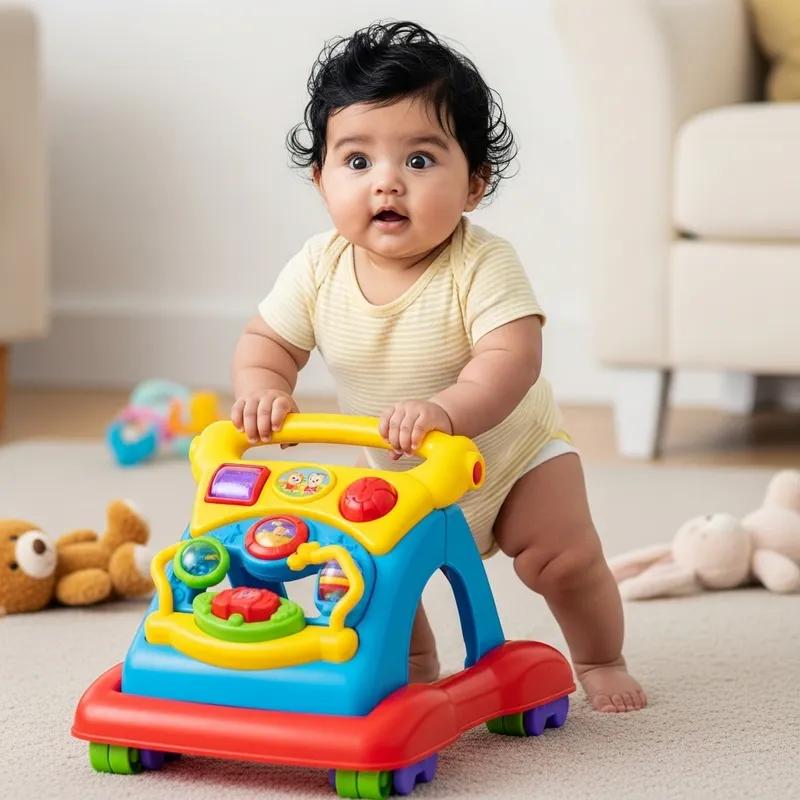
From Crawling to Cruising: Understanding the Milestones of Your Baby’s First Steps
The Grandest Milestone
Few moments in parenting are as exhilarating as those first wobbly, independent steps. But walking isn't just a physical feat; it is a massive neurological event. To move from four limbs to two, a baby’s brain must rewire itself for a completely different center of gravity. At Mamaverse, we look at the internal "Biological Clock" of walking and how tools like baby walkers can be part of the environment that encourages this monumental transition.
1. The Vestibular System: The Internal Gyroscope
Before a baby can walk, they must develop a sense of balance. This is controlled by the vestibular system in the inner ear. When a baby stands in a StarAndDaisy activity walker, they are receiving feedback about their vertical orientation.
The stability of a baby's upright posture can be modeled by the Inverted Pendulum theory:
$$T = 2\pi \sqrt{\frac{L}{g}}$$
Where $L$ is the distance from the pivot (the ankles) to the center of mass. Because babies have relatively large heads, their $L$ is high, making them naturally top-heavy. The wide base of a StarAndDaisy walker acts as an external stabilizer while the brain calibrates this internal pendulum.
2. Proprioception: Knowing Where Your Feet Are
Proprioception is the "sixth sense" that tells us where our limbs are in space without looking at them. When a baby "cruises" along furniture or uses a sit-to-stand walker, they are training their nerve endings to send signals to the cerebellum.
The StarAndDaisy app features walkers with textured floor-grip wheels, which provide the tactile resistance necessary for the baby to feel the "push-back" of the ground, a vital part of building foot-eye coordination.
3. Muscle Memory and the "Gait Cycle"
Walking is a repeating cycle of "Stance" and "Swing." In the early stages, babies don't have a heel-to-toe strike; they flat-foot or toe-walk. Using a push walker allows the baby to control the speed of their forward momentum while they practice the Swing Phase of their gait.
By holding onto the handle of a StarAndDaisy push walker, the baby maintains a "fixed point" of stability, reducing the fear of falling and allowing them to focus entirely on the mechanics of their leg movements.
4. The Psychological Boost of Verticality
There is a massive shift in a baby’s confidence when they move from the floor to eye-level with the world. This vertical perspective encourages social interaction. Being in a StarAndDaisy interactive walker allows them to move toward their parents or toys, fostering a sense of agency and independence that is critical for emotional development.
Conclusion
Walking is a journey that starts long before the first step. By understanding the physics of balance and the biology of proprioception, you can better appreciate the work your little one is doing every day. Whether they are cruising the couch or pushing their favorite StarAndDaisy walker, they are engineering their own independence. Celebrate every wobble!