Building Strong Foundations: The Biomechanics of Leg Development in the Walking Phase
Building Strong Foundations: The Biomechanics of Leg Development in the Walking Phase
Building Strong Foundations: The Biomechanics of Leg Development in the Walking Phase
The Load-Bearing Journey
Before a baby can take a step, their legs must undergo a series of structural changes. At birth, an infant’s legs are bowed, and their bones are mostly flexible cartilage. As they begin to pull themselves up, gravity begins its work, stimulating the hardening of bones and the tightening of ligaments. A baby walker can be a supportive tool in this "Load-Bearing" phase. At Mamaverse, we examine the physics of infant leg strength and how to use gear to support natural growth.
1. Wolff’s Law: Why Mechanical Stress Matters
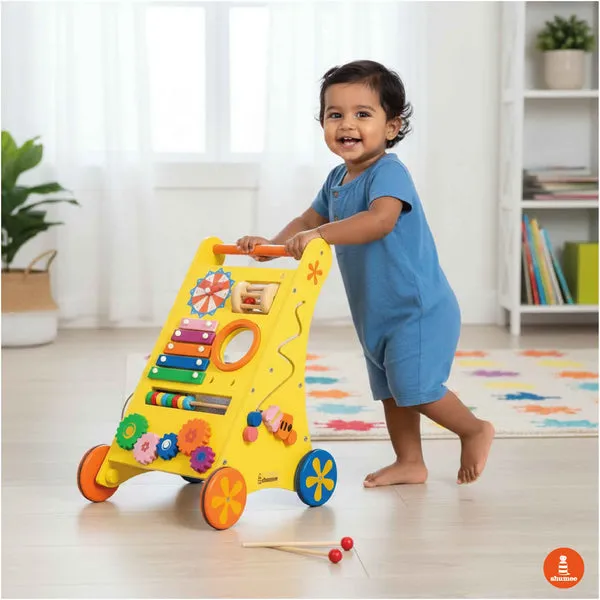
There is a principle in anatomy known as Wolff’s Law: bone grows or remodels in response to the forces or demands placed upon it. When a baby stands in a StarAndDaisy activity walker, the downward force of their weight creates "micro-strains" in the bone tissue, signaling the body to deposit calcium and increase bone density.
The pressure exerted on the femur can be simplified as:
$$Stress (\sigma) = \frac{Force (F)}{Cross-Sectional Area (A)}$$
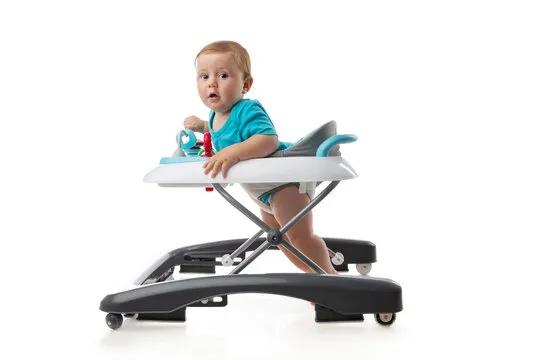
By providing a stable environment to practice standing, the walker helps distribute this Stress ($\sigma$) safely. A StarAndDaisy walker with an adjustable height setting ensures that the baby’s feet are flat on the floor, allowing for proper weight distribution through the heels and arches, rather than just the toes.
2. Muscle Chain Activation: From Core to Calves
Walking is a full-body workout. It requires the "Posterior Chain" (the muscles on the back of the body) to fire in a specific sequence.
- The Core: Stabilizes the spine as the baby reaches for toys on the tray.
- The Glutes: Provide the power to push the walker forward.
- The Quadriceps: Extend the knee during the "Swing Phase" of movement.
3. Hip Stability and the Acetabulum
The "hip socket" (acetabulum) in a baby is shallow. Movement is what helps deepen this socket, ensuring the femur head stays securely in place. The walking motion—even when supported by a StarAndDaisy walker—promotes the circulation of synovial fluid in the joints, which provides the lubrication and nutrients needed for healthy joint development. The wide seat of a seated walker is specifically designed to maintain the "M-position" of the hips, protecting against dysplasia while allowing for leg movement.
Conclusion
Your baby’s legs are incredible pieces of biological engineering. By providing the right amount of mechanical stress through standing and the right muscle activation through pushing, you are helping them build a foundation for a lifetime of movement. Explore the ergonomically designed walkers at StarAndDaisy that grow alongside your baby’s milestones.