The Physics of Crash Protection: Why Rear-Facing and Side-Impact Tech Save Lives
The Physics of Crash Protection: Why Rear-Facing and Side-Impact Tech Save Lives
The Physics of Crash Protection: Why Rear-Facing and Side-Impact Tech Save Lives
The Mathematical Reality of a Collision
In the event of a car accident, a baby car seat has a split second to manage massive amounts of kinetic energy. To an adult, a 50km/h impact is a shock; to an infant, it is a life-altering event. At Mamaverse, we dive into the physics of car seat engineering—from G-force reduction to energy-absorbing foams—to explain why certain safety standards are non-negotiable for your family vehicle.
1. The "Rear-Facing" Logic: Distributing the Load
Why must infants stay rear-facing until at least age two? It comes down to the Newtonian Law of Motion. In a frontal collision, anything not anchored is thrown forward. If a baby is forward-facing, their heavy head is thrown forward with immense force, putting the entire load on the fragile neck ligaments.
$$Force (F) = mass (m) \times acceleration (a)$$
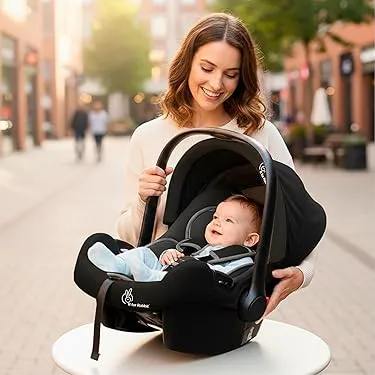
In a rear-facing StarAndDaisy car seat, the "shell" of the seat cradles the baby. The force of the impact is distributed across the entire back of the seat, which supports the head and spine as a single unit. This reduces the load on the neck by over 90% compared to a forward-facing position.
2. Side-Impact Protection (SIP) and Energy Absorption
While cars have "crumple zones" for the front and back, the sides of a vehicle offer very little protection. Modern StarAndDaisy baby car seats incorporate SIP technology—often in the form of "Wings" or "Damping Pods." These pods are made of EPP (Expanded Polypropylene) or EPS foam. These materials are designed to compress at a controlled rate, converting kinetic energy into thermal energy and preventing it from reaching the baby’s torso.
3. ISOFIX: Eliminating Human Error
A car seat is only as safe as its installation. Research shows that up to 70% of car seats installed with seatbelts are fitted incorrectly. The ISOFIX system—standard on the StarAndDaisy app—connects the seat directly to the car's chassis via rigid metal anchors. This creates a solid "Mechanical Union," ensuring the seat doesn't pivot or slide during a crash. Look for "Green Indicators" on the ISOFIX base to confirm a secure lock.
4. The "No-Pinch" 5-Point Harness
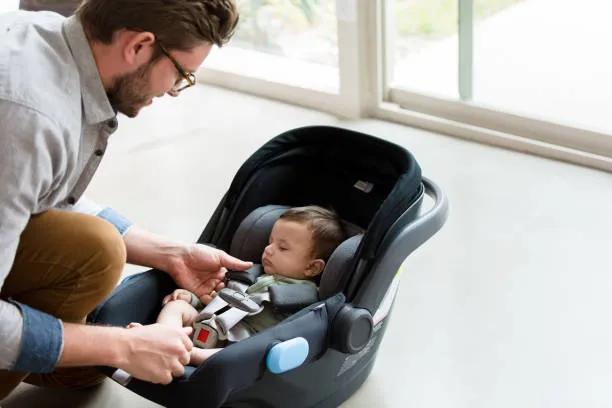
The harness in a car seat must be tight enough that you cannot pinch the webbing between your fingers. A StarAndDaisy car seat uses "Energy-Absorbing Ribs" on the shoulder pads. In an accident, these pads slightly stretch, providing a "soft-stop" for the baby’s chest, further reducing the G-force experienced by the internal organs.
5. Expiry Dates and Material Fatigue
Many parents don't realize that car seats have expiry dates. Over time, the plastic shell is subjected to extreme temperature fluctuations inside a car (from -10°C in winter to 60°C in summer). This leads to Polymer Degradation, making the plastic brittle. When you purchase from StarAndDaisy, you are guaranteed a seat with the latest manufacturing date, ensuring the structural integrity of the polymers is at its peak.
Conclusion
A car seat is the most important "insurance policy" you will ever buy for your child. By understanding the physics of rear-facing support, the chemistry of EPP foam, and the reliability of ISOFIX, you can make a choice based on science rather than style. Protect your most precious cargo with the safety-engineered range at StarAndDaisy.