Tidy Space, Tidy Mind: How Organized Cupboards Support Your Toddler’s Focus and Independence
Tidy Space, Tidy Mind: How Organized Cupboards Support Your Toddler’s Focus and Independence
Tidy Space, Tidy Mind: How Organized Cupboards Support Your Toddler’s Focus and Independence
The Visual Overload Problem
We often think of baby storage and cupboards as a way to keep our lives easier. But did you know that the way you organize your child’s room directly impacts their brain development? A cluttered environment can lead to "Overstimulation," making it difficult for a toddler to focus on a single task. At Mamaverse, we explore the psychology of storage and how a "Minimalist Cupboard" approach can foster independence and calm.
1. Cognitive Load and Choice Paralysis
When a child sees 50 toys scattered on a shelf, their brain experiences Choice Paralysis. The "Cognitive Load" required to pick one toy becomes so high that they often end up playing with nothing, or worse, having a meltdown.
The Toy Rotation Theory suggests that less is more:
$$Engagement \propto \frac{1}{Visible Items}$$
By using a StarAndDaisy closed-door cupboard, you can hide the majority of the "visual noise." Keep only 4–5 toys visible on an open shelf and rotate them weekly. This makes the "new" toys exciting again and allows the child’s prefrontal cortex to focus on deep, imaginative play rather than a chaotic search.
[Image: Comparison of a cluttered open toy shelf vs. a clean StarAndDaisy cupboard with 3 curated toys]2. Promoting the "I Can Do It" Milestone
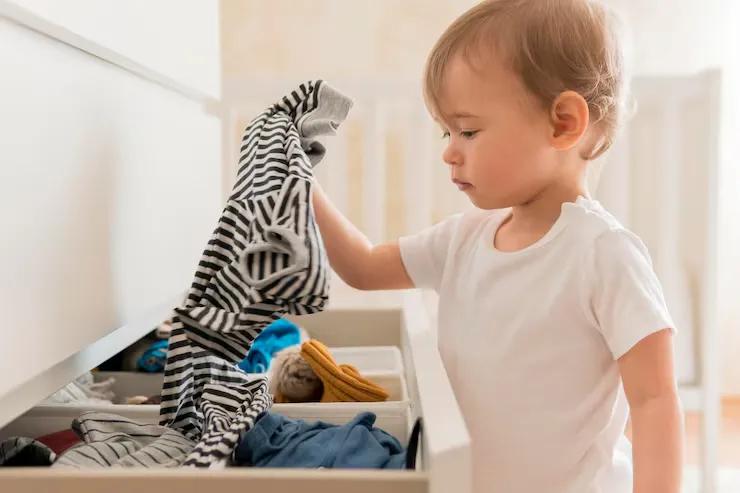
Independence starts with accessibility. If your child's clothes are stored in a high dresser they can't reach, they remain dependent on you for every wardrobe change.
An "Independence Zone" in your StarAndDaisy wardrobe involves placing socks, pajamas, and simple t-shirts in the bottom drawers. When a child can successfully "fetch" their own socks, it triggers a dopamine release in the brain associated with Self-Efficacy—the belief that they are capable individuals.
3. The Routine of "Restoration"
Organization is a life skill. By using low-level storage bins with picture labels (a drawing of a car for the car bin, a block for the block bin), you teach your toddler the concept of "Restoration."
On the StarAndDaisy app, look for storage units with removable bins. These are perfect for "Cleanup Races," where the goal is to return every item to its "Home." This isn't just cleaning; it's teaching Categorization—a fundamental mathematical and logical skill.
4. Creating a "Quiet Zone" for Sleep
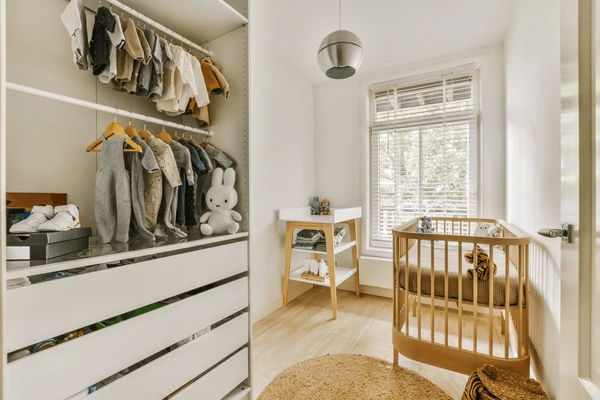
The bedroom should be a place for rest, but it's hard to sleep when a cupboard full of bright toys is staring you in the face. Using opaque cupboard doors or fabric bins in neutral tones helps signal to the brain that "Playtime is Over." By tucking the "High-Energy" toys away in a StarAndDaisy cupboard, you create a visual transition that makes the bedtime routine much smoother.
Conclusion
Your nursery storage is more than a place for "stuff"—it’s a tool for teaching focus, independence, and calm. By reducing visual noise and creating accessible zones, you are helping your child’s mind thrive. Discover the psychology-backed storage designs at StarAndDaisy and watch your toddler grow in confidence.